
Home Practice That Actually Sticks: How to Set Up Between-Session Activities for Your Clients

Most therapy goals require repetition. Yet many clients only see their therapist once a week. That creates a challenge.
A therapist may spend 45 minutes introducing a new strategy, practicing a target skill, and providing feedback. But what happens during the six days before the next session? For many clients, very little. And that's not because therapy isn't effective. It's because learning, skill acquisition, and neuroplasticity depend on repeated practice over time.
Meta-analyses of cognitive behavioral therapy show that between-session homework and repeated practice are directly linked to stronger skill retention and better treatment outcomes. Without opportunities to revisit skills between sessions, progress is often slower, carryover is limited, and therapists find themselves reteaching concepts week after week. That's why effective home practice isn't just a nice addition to therapy—it's often one of the most important factors influencing long-term outcomes. Research indicates that homework completion is positively associated with treatment outcome and that greater homework compliance predicts better posttreatment results. The challenge is creating between-session activities that clients will actually complete.
Why Repetition Matters
Whether you're working on cognitive rehabilitation, speech and language development, executive functioning, attention, or social-emotional skills, one principle remains consistent: Skills improve through repetition. Therapy sessions provide an opportunity to introduce new strategies, model skills, provide feedback, and adjust interventions. But lasting change happens when those same skills are practiced repeatedly in meaningful contexts. Research across rehabilitation, education, and motor learning consistently shows that distributed practice—short learning opportunities spread over multiple days—leads to stronger retention and better long-term outcomes than infrequent practice alone. Neuroscience studies show that repeated practice strengthens synaptic connections and supports neuroplastic changes that underlie skill acquisition. In other words, a client who practices for five minutes each day may benefit more than a client who only engages with a target skill during a single weekly therapy session. The therapist introduces the skill. Daily practice helps strengthen it.
Understanding the Dosage Gap
One of the biggest barriers to progress is the gap between therapy sessions. A client attending a 45-minute session once per week receives less than one hour of direct intervention across 168 hours. Even the most effective therapy session cannot compensate for limited opportunities to apply and reinforce skills throughout the week. For many clients, the issue is not the quality of therapy. It's the lack of consistent practice between appointments. This is particularly important for:
- Cognitive rehabilitation
- Executive functioning interventions
- Speech and language therapy
- Attention training
- Memory strategies
- Social-emotional learning
These skills typically require repeated exposure before they become automatic and transferable to everyday situations. The goal is not necessarily more therapy. The goal is more meaningful repetitions.
What Makes Home Practice Successful?
Many therapists assign home activities with the best intentions. Unfortunately, traditional homework programs often create unintended barriers. Activities may be:
- Too long
- Too generic
- Difficult to understand independently
- Hard for caregivers to support
- Easy to forget during a busy week
The most effective between-session activities tend to share four characteristics.
- They Are Short - Short activities feel manageable. A five-minute exercise is much easier to complete consistently than a lengthy worksheet or a complex assignment.
- They Are Personalized- Clients are more likely to engage when activities reflect their interests, goals, and abilities. Personalization increases motivation and supports carryover into real-world situations.
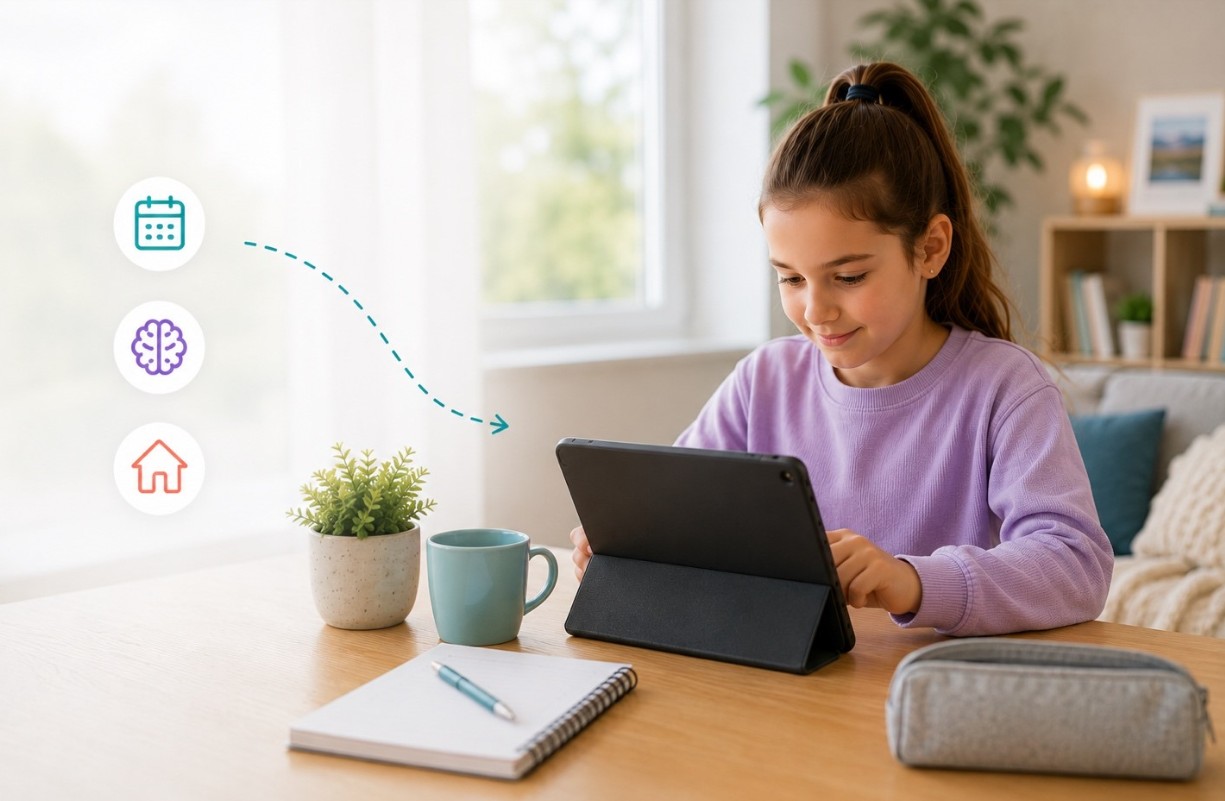
- They Are Easy to Access - The fewer barriers, the better. If clients can immediately access an activity on a tablet, computer, or phone, participation becomes much more likely.
- They Fit Naturally Into Daily Life - Successful home practice becomes part of existing routines rather than another task on an already crowded schedule.
The Growing Role of AI Therapy Tools
Creating individualized home activities for every client can be time-consuming. This is where AI therapy tools are beginning to transform clinical practice. Artificial intelligence is not replacing therapists. Instead, it functions as assistive technology for clinicians—helping reduce preparation time while making personalized care easier to deliver. AI-powered tools can help therapists:
- Create individualized activities faster
- Adapt content to different ability levels
- Generate new practice opportunities
- Increase engagement through personalization
- Support continuity between sessions
This allows clinicians to spend more time focused on treatment and less time creating materials from scratch.
A Real-Life Example: From Weekly Practice to Daily Learning
Consider Noah, an 11-year-old client working on attention and executive functioning skills. During therapy sessions, Noah performed well with support from his therapist. However, by the following week, many of the strategies introduced during treatment had been forgotten or inconsistently applied. Instead of increasing therapy frequency, his therapist focused on increasing practice opportunities. Short daily activities were assigned that reinforced the same skills addressed during treatment. Each activity took less than five minutes.
Over the course of a week, Noah completed dozens of additional learning opportunities before returning to therapy. The difference wasn't more therapy. It was more repetition. Over time, those small daily interactions helped strengthen the skills introduced during sessions and improved carryover into everyday situations. This pattern aligns with findings that distributed, between-session practice produces stronger learning and retention than massed practice in a single session.
How Cognishine Supports Between-Session Practice
One of the biggest challenges therapists face is finding the time to create meaningful, individualized home activities. Cognishine was designed to help solve this problem. As an AI-powered digital therapy platform, Cognishine provides therapists with access to a growing library of evidence-based activities targeting cognitive skills, communication, language, executive functioning, social-emotional learning, and more. Instead of relying solely on paper-based homework, therapists can assign interactive activities that align directly with treatment goals and can be completed independently between sessions. Cognishine supports:
- Home practice programs
- Cognitive rehabilitation
- Speech and language therapy
- Executive functioning interventions
- Teletherapy and hybrid care
- Independent client practice
- Remote rehabilitation solutions
Using AI-supported tools, therapists can quickly personalize activities to match a client's interests, strengths, and therapeutic objectives. This helps transform a single weekly therapy session into multiple opportunities for learning throughout the week. Rather than asking clients to simply remember what they practiced, Cognishine allows them to actively revisit and strengthen those skills every day. Digital therapy platforms that support between-session practice are associated with improved continuity of care and greater skill generalization to everyday contexts.
The Future of Rehabilitation Is Continuous
Therapy is no longer limited to the clinic. Today, digital therapy platforms make it possible to support learning, engagement, and skill development between sessions in ways that were not possible just a few years ago. For therapists, this creates an opportunity to extend the impact of every session. For clients, it creates more opportunities to practice, succeed, and build confidence. And for outcomes, it helps bridge the gap between what happens during therapy and what happens in everyday life. Ongoing research in digital therapeutics and rehabilitation science shows that continuous, between-session practice is a key driver of long-term functional improvement.
The Bottom Line
Weekly therapy sessions are important. But progress depends on what happens between them. Research consistently shows that repeated practice supports stronger learning, better retention, and improved carryover of skills. Meta-analyses confirm that homework compliance and between-session practice are positively associated with treatment outcomes across multiple psychotherapy modalities. When home activities are short, personalized, engaging, and easy to access, clients are far more likely to continue practicing throughout the week. Platforms like Cognishine help therapists make this possible by providing personalized, AI-supported activities that extend learning beyond the therapy room and create more opportunities for meaningful repetition. Instead of asking: "Why aren't my clients completing their home program?" Try asking: "How can I create more opportunities for practice between sessions?" Because sometimes the biggest gains happen during the six days between therapy appointments.
About the Author
Melina Mathis is a speech-language therapist with experience working across a diverse range of pediatric and adult populations. Her clinical work includes supporting individuals with cleft lip and palate, who often require long-term interdisciplinary care throughout childhood, as well as adults with orofacial myofunctional disorders, temporomandibular dysfunction (TMD), sleep-disordered breathing, and chronic mouth breathing.
In addition to her work in outpatient and home-based care, Melina has a strong interest in augmentative and alternative communication (AAC), helping individuals with complex communication needs participate more fully in everyday life.
Her clinical philosophy centers on patient motivation, autonomy, and meaningful participation. She believes that therapy is most effective when patients understand their goals, feel empowered in the therapeutic process, and have access to engaging, individualized opportunities for practice beyond the therapy session.
Alongside her clinical work, Melina contributes as a freelance content creator for Cognishine, where she shares insights on rehabilitation, communication, assistive technology, and patient-centered approaches to care.
References
Abramowitz, J. S., Franklin, M. E., Zoellner, L. A., & DiBernardo, M. (2002). Guidelines for enhancing homework compliance. Journal of Clinical Psychology, 58(5), 565–576.
Kazantzis, N., & L’Abate, L. (Eds.). (2007). Handbook of homework assignments in psychotherapy: Research, practice, and prevention. Springer.
Kazantzis, N., Whittington, C., & Dattilio, F. (2010). Meta-analysis of homework effects in cognitive and behavioral therapy: A replication and extension. Clinical Psychology: Science and Practice, 17(2), 144–156.
Maguire, K., Harder, V. A., & Williams, G. C. (2022). Integrating between-session homework in psychotherapy: A systematic review of immediate in-session and intermediate outcomes. Psychotherapy. https://pubmed.ncbi.nlm.nih.gov/37104804/
Perkins, T., Ruzek, J. I., & others. (2023). Engagement with homework in an internet-delivered therapy program predicts treatment response.
Pike, A., & others. (2016). Retrieval practice and spacing effects in multi-session naming treatment in aphasia.
Stokes, T. F., & Baer, D. M. (1977). An implicit technology of generalization. Journal of Applied Behavior Analysis, 10(2), 349–367.
