
Rethinking Hierarchy in Aphasia Therapy: A TUF-Informed Perspective (Treatment of Underlying Forms)

At a glance
What is Treatment of Underlying Forms (TUF)?
A sentence-level, evidence-based approach that targets complex sentence structures first, aiming to support broader language change rather than progressing only from smaller to larger units.
Who is it best suited to?
Best for individuals with aphasia who can engage meaningfully with sentence-level context. Those with milder impairments tend to show larger gains, and the approach can be adapted with support for more significant difficulty.
Why use a TUF-informed approach?
A 2021 Bayesian meta-analysis of TUF studies found consistent evidence that sentence-level treatment increases accuracy during therapy, with larger gains for trained sentences and some generalization to related, less complex sentences. The study also showed that treatment effects grow with more sessions, and that clients with milder aphasia tend to benefit more.

Complexity first: The core idea
Rather than starting with simpler, shorter units, Treatment of Underlying Forms (TUF) targets complex sentence structures from the outset. The underlying idea is that working at a higher level of linguistic complexity can drive broader change in the language system as a whole. In this framework, the sentence is not the final outcome — it is the means by which underlying representations are strengthened.
More recent research continues to support this approach. A Bayesian meta-analysis by Thompson (2021), synthesizing findings across multiple TUF studies, demonstrated robust treatment effects for sentence-level intervention. Importantly, the analysis showed that gains were not limited to trained structures: in many cases, improvement generalized to related, less complex sentence forms, whereas the reverse pattern — training simple forms and expecting generalization upward — remains far less reliable.
Clinically, this helps make sense of something many of us observe in practice: some clients retrieve words more easily within sentence contexts than in isolation, and their speech can sound more stable and organized when supported by structure and meaning. Sentence-level work can reduce cognitive and motor demands by distributing the load across semantic, syntactic, and pragmatic cues.
TUF does not suggest that word-level practice is unnecessary or ineffective. Rather, it challenges the assumption that therapy must always progress from simple to complex. For some speakers, sentences provide scaffolding rather than overload, offering a more functional and neurologically efficient pathway to language recovery.
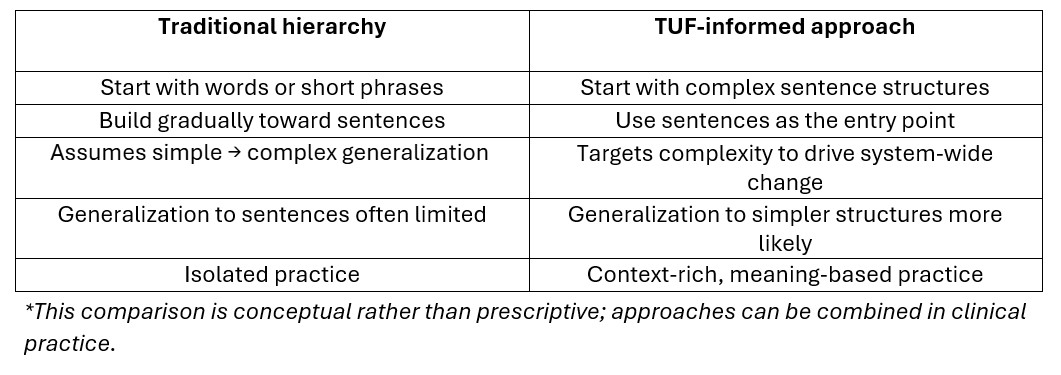
How to explain TUF to the patient’s family?
Instead of practicing single words and hoping they later fit into sentences, we sometimes start with whole sentences. The sentence gives the brain more support — meaning, structure, and context — which can actually make it easier to find words and say them more clearly. This doesn’t mean we are skipping simpler practice altogether — it means we are using sentences to provide support.
This approach is supported by research showing that practicing more complex language can help improve simpler language too, especially when therapy is well-matched to the person and given enough time.
FAQ
What is Treatment of Underlying Forms (TUF)?
TUF is a sentence-level approach that targets complex sentence structures to support broader language change, rather than building up gradually from isolated words.
Who is TUF suitable for?
It is best suited to individuals with aphasia who can engage with sentence-level material, particularly those who show limited carryover from word-level practice.
How can speech-language therapists use TUF in practice?
SLPs can apply TUF principles by introducing sentence-level tasks earlier, using complex structures, and allowing sentence context to support word retrieval and speech stability.
Is TUF appropriate for everyone?
No. TUF is not a one-size-fits-all approach and should be used selectively, based on comprehension, severity, and the individual’s response to therapy.
Why might sentence-level work help more than word-level practice for some clients?
Sentence context provides semantic and syntactic support that can reduce cognitive and motor load, making word retrieval easier and speech more stable.
Can TUF be used in teletherapy?
Yes. TUF adapts well to teletherapy platforms and online therapy tools, as sentence-level work can be delivered through structured visual stimuli, reading, and discussion. Remote rehabilitation solutions and accessible therapy software allow sentence-based therapy to continue effectively for home use when supported by clinician guidance.
About the author
Alona Novak is a Portugal-based speech and language therapist at Cognishine and a practicing clinician in stroke rehabilitation, working across aphasia, apraxia of speech, and dysarthria. She also works with voice disorders and provides therapy in Hebrew and Russian.
Explore more aphasia therapy guides and free resources from Cognishine:
Melodic Intonation Therapy (MIT) for Aphasia: A Guide for SLPs
Semantic Feature Analysis (SFA) for Word Finding Difficulties: A Guide for SLPs
Key references
- Thompson, C. K. (2021). Treatment of underlying forms: A Bayesian meta-analysis of the effects of treatment and person-related variables on treatment response. Journal of Speech, Language, and Hearing Research, 64(10), 4033–4052.
- Thompson, C. K., & Shapiro, L. P. (2007). Complexity in treatment of syntactic deficits. American Journal of Speech-Language Pathology.
- Shapiro, L. P., & Thompson, C. K. (2006). Treatment of underlying forms: A linguistic approach.
