
Screen Time Through a Therapy Lens: Finding the “Just Right” Balance (Screen Time - Part 1)

Screens are everywhere - at home, in school, waiting rooms, and increasingly, as part of therapy routines. For clinicians and parents alike, the real question is no longer “screens: yes or no?” but rather:
How much? What kind? And with what support?
(Canadian Paediatric Society, 2017)
In occupational therapy practice - especially during and after the COVID era-many children genuinely benefited from a thoughtful blend of on-screen and off-screen activities, where screens were used intentionally while movement, play, and real-world participation remained at the center of the plan.
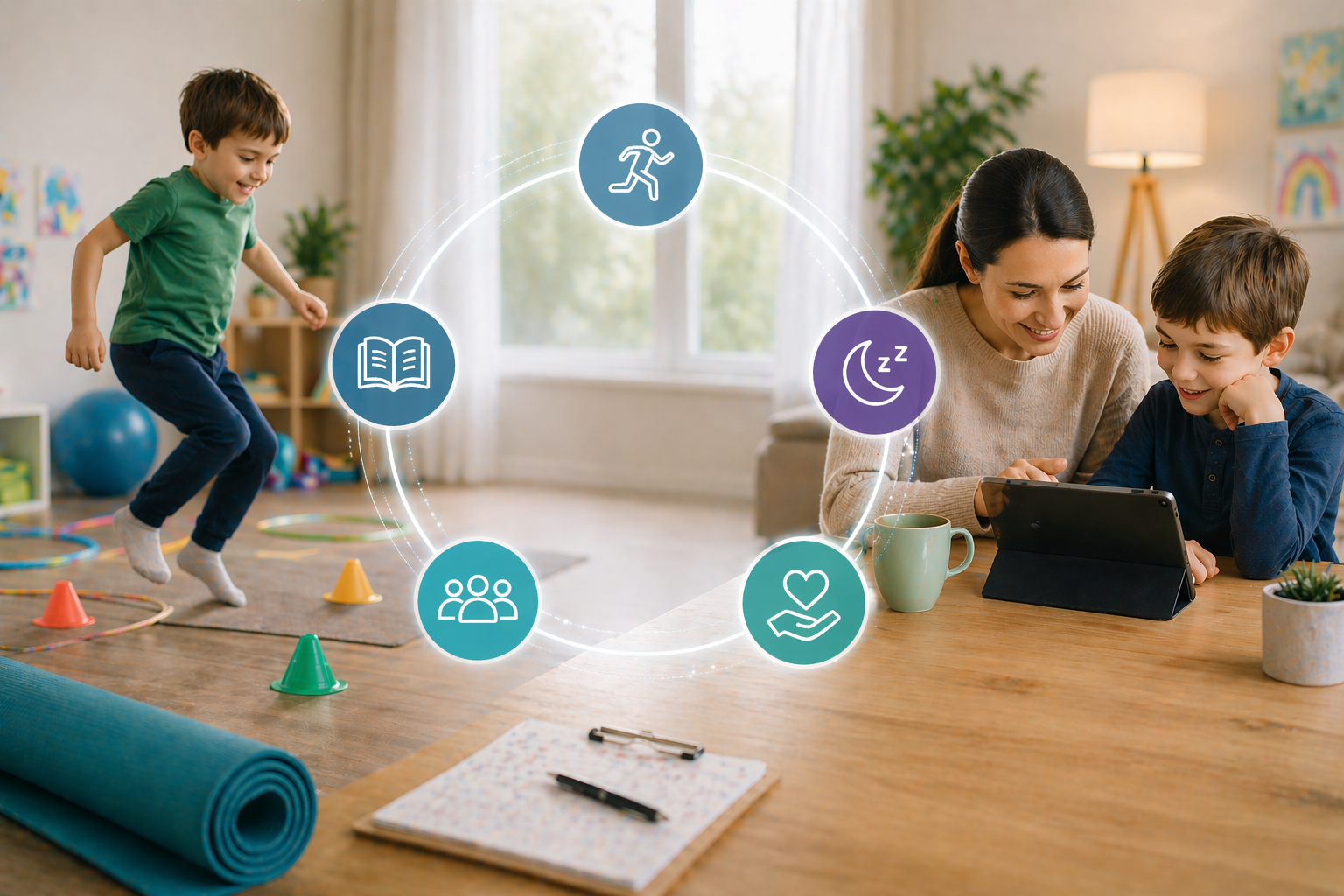
Screens Aren’t the Enemy - They’re a Tool
For occupational therapists, the takeaway is clear:
Screens are neither inherently harmful nor automatically therapeutic. They are simply one tool in a child’s environment.
(American Academy of Pediatrics, 2016)
What matters most is the dose, the purpose, and the supports around screen use. These factors determine whether screens support or disrupt a child’s core occupations, including:
- play
- learning
- sleep
- self-care
- social participation
When we frame screen time through an occupational therapy lens, we can step away from guilt-driven, all-or-nothing rules and move toward practical, family-specific plans that actually work in real life.
(Canadian Paediatric Society, 2022)
Screen Time Is Part of a Bigger 24-Hour Picture
Modern health guidance increasingly views screen time as one part of a larger daily balance - alongside movement, sleep, and meaningful connection.
(Saunders et al., 2016)
For young children, the message is simple:
“Sit less and play more.”
Very limited sedentary screen time is recommended in the early years. As children get older, guidelines tend to focus on balancing:
- physical activity
- sleep
- sedentary behavior (including recreational screen use)
Pediatric experts consistently emphasize that quality matters more than quantity. High-quality content, co-viewing with an engaged adult, and consistent family plans are often more impactful than rigid time limits alone.
(American Academy of Pediatrics, 2016)
That said, research repeatedly links higher screen time - especially in the evening-with poorer sleep outcomes for school-aged children and teens. (Hale & Guan, 2015)
When Screens Work Best: Purposeful, Supported Use
Screens tend to be most helpful when they are used on purpose, not as a default.
High-quality educational media becomes far more powerful when paired with caregiver co-viewing-for example:
- commenting on what the child sees
- asking questions
- connecting the content to real-life experiences
This transforms passive watching into active language, knowledge, and skill building.
(Canadian Paediatric Society, 2017)
Digital tools can also support social connection through:
- video calls with distant family
- collaborative games
- creative platforms
These can be especially meaningful for children who struggle socially or experienced isolation during pandemic years.
In occupational therapy practice, “on-purpose” screen use might target:
- visual-motor coordination (short, structured games)
- executive function (timers, schedules, planning apps)
- communication (AAC apps)
- graded attention training, paired with movement breaks
How I Used Screens in School-Based OT Practice
In my school-based practice, screen time was never a “one size fits all” approach. How we used it depended entirely on what each child needed when they walked into the therapy room.
A child who arrived wired, restless, or dysregulated might begin with a short movement circuit such as:
- jumping jacks
- animal walks
- quick dance breaks
This helped release energy and organize the body.
A child who arrived tired, overwhelmed, or shut down was more likely to start with calming sensory input or guided breathing to lower arousal and create a sense of safety.
(Canadian Paediatric Society, 2022)
From there, we might layer in a brief, intentionally chosen video as a co-regulated transition tool before shifting to seated work such as writing.
Used this way - brief, predictable, and embedded within a larger regulation routine - screen time remained one small support, never the center of the session.
A Real-Life Example: Jonah’s After-School Meltdown Cycle
Consider Jonah, a 7-year-old who returned home after school exhausted and easily frustrated. His parents noticed that giving him a tablet “just to keep the peace” often snowballed into long stretches of screen time, followed by explosive transitions when it was time to stop.
With guidance, families like Jonah’s can learn to reframe the routine:
- Start with movement (a short, high-energy game after school)
- Follow with a short, calm video watched together
- Transition into a predictable screen-free activity like snack time or table play
In this routine, the screen becomes a short and reliable transition tool, securely anchored between movement and real-world interaction - rather than the main event of the evening.
From an occupational therapy perspective, the goal isn’t screen elimination - it’s ensuring screens remain just one small thread in a rich daily tapestry of movement, play, sleep, learning, and connection.
When families find their own “just right” balance, screen time can coexist with thriving development-and children’s core occupations stay firmly at the center.
(Canadian Paediatric Society, 2022)
About the author
Elaine Wiener, OTR/L is a pediatric occupational therapist with over 25 years of experience working in school-based settings with children in preschool and elementary school, as well as experience with the early intervention population. She has taken numerous courses to deepen her understanding of sensory integration and applied these principles in school practice by intentionally blending on-screen and off-screen activities in the therapy room, while also supporting teachers with strategies they could integrate into the classroom. She currently serves as the U.S. Website Manager and Clinical Business Development Manager at Cognishine, developing practical, accessible resources for families, therapists, and educators.
References
- Canadian Paediatric Society. (2017). Screen time and young children: Promoting health and development in a digital world.
- Canadian Paediatric Society. (2022). Screen time and preschool children.
- Saunders, T. J., et al. (2016). Canadian 24-Hour Movement Guidelines for Children and Youth.
- Hale, L., & Guan, S. (2015). Screen time and sleep among school-aged children and adolescents.
- American Academy of Pediatrics. (2016). Media and young minds.
