
Script Training for Aphasia: A Guide for SLPs

At a glance
What is it?
Script Training is a functional treatment approach in which the clinician and person with aphasia co-create a short, personally relevant monologue or dialogue for a situation that matters in daily life, then practice it repeatedly so production becomes easier, faster, and more reliable.
Who is it for?
It is most useful when the person has a clear participation goal and would benefit from having a dependable way to communicate in a specific real-life situation.
Why use it?
Its purpose is not to improve every aspect of language. Its purpose is to support successful communication in specific, meaningful contexts.
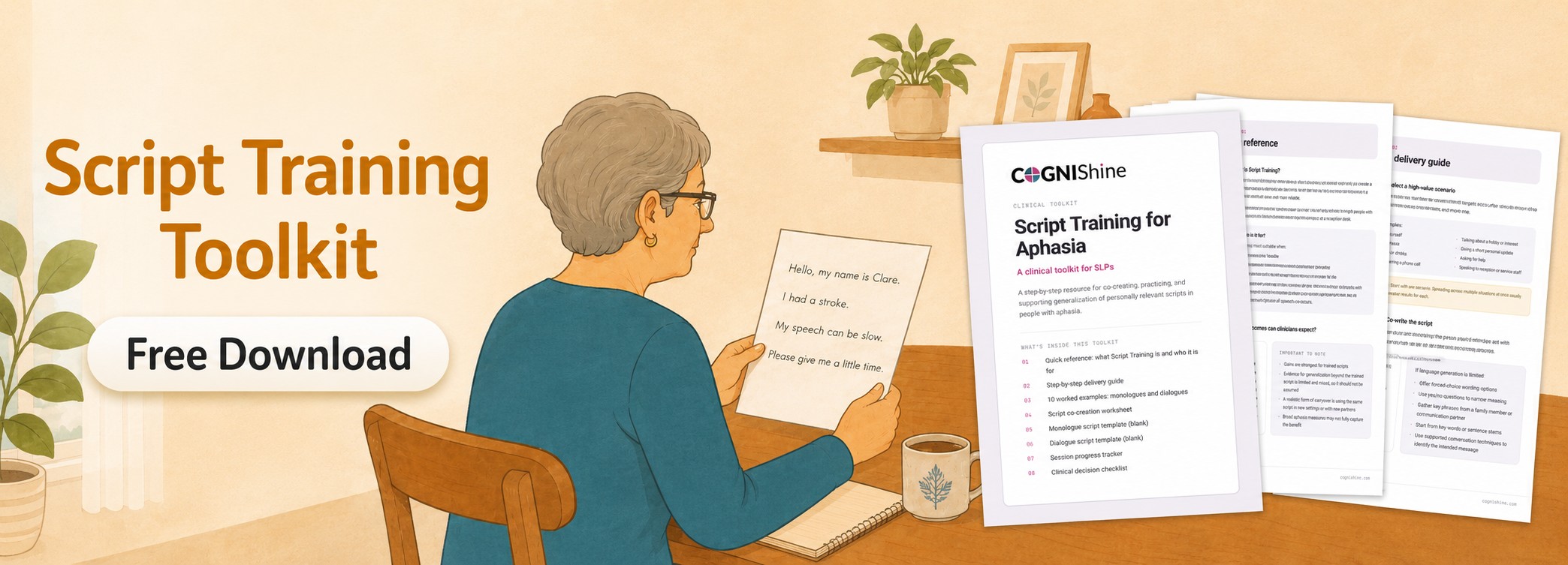
Download the free Script Training Toolkit
How does Script Training work?
Script Training is a practical, evidence-based, participation-focused treatment approach for people with aphasia. Rather than targeting language broadly across every topic, it focuses on helping the person say something useful and meaningful in a situation that matters to them (ASHA, n.d.; Hubbard et al., 2020).
A “script” is a predictable sequence of sentences for a familiar event. It might be a self-introduction, a short explanation, or a brief exchange in a café, on the phone, or at a reception desk.
The goal is not broad language change across every topic. The goal is dependable communication in situations that the person values (Hubbard et al., 2020).
Script Training is most suitable when:
· the person has a clear participation goal
· repeated practice is feasible
· success in one specific situation would increase confidence or reduce communication breakdown
· a dependable, predictable speech routine would be genuinely useful in daily life
Script Training has been used with people with stable aphasia following stroke and with people with primary progressive aphasia. It can be delivered face-to-face, in groups, via telepractice (teletherapy), and as supported home practice. It can also be adapted when apraxia of speech co-occurs (Hubbard et al., 2020; Youmans et al., 2011).
What outcomes can clinicians expect?
Most likely gains
· improved accuracy and completeness of the trained script
· improved speaking rate, ease, or fluency on the script
· greater confidence in the targeted situation
· a reported sense of being more prepared and more understood
These are the types of gains most commonly reported in the script training literature, particularly on trained scripts themselves (Cherney et al., 2008; Cherney et al., 2011; Goldberg et al., 2012).
Important to note
· gains are strongest for trained scripts
· evidence for generalization beyond the trained script is limited and mixed, so it should not be assumed
· a realistic form of carryover is using the same script in new settings or with new partners
· broad aphasia measures may not fully capture the benefit
This pattern is consistent across the literature: strong gains on practiced scripts, some maintenance, and more mixed evidence for broader generalization (Cherney et al., 2008; Goldberg et al., 2012; Hubbard et al., 2020).
What does a script actually look like?
Scripts are usually short, specific, and functional. For example:
Example monologue: self-introduction
Scenario: meeting someone new at a community group
“Hello, my name is John.
I had a stroke.
My speech can be slow.
Please give me a little time.”
Example monologue: talking about a hobby
Scenario: making conversation with a friend or at a group
“I like gardening.
I grow tomatoes and herbs in my backyard.
It helps me relax and I enjoy being outside.”
Example dialogue: ordering a drink
Partner: “What would you like?”
Person: “Tea, please.”
Partner: “Milk and sugar?”
Person: “Milk, no sugar, thank you.”
These examples illustrate the core idea: the target is not abstract language improvement. The target is reliable communication in a situation the person is likely to face in real life.

What makes Script Training useful in practice?
Script Training is based on repeated practice of whole, meaningful utterance sequences. In the literature, it is commonly discussed in relation to automatization, repeated retrieval and production, and the value of practicing language in realistic, context-bound routines (Hubbard et al., 2020).
This makes Script Training particularly useful when success in one specific situation would make participation easier, increase confidence, or reduce communication breakdown in everyday life.
How do you deliver Script Training?
Download the free Script Training Toolkit here
Step 1: Select a high-value scenario
Begin with one situation that matters to the person. Good targets occur often enough to be worth practicing and would make a real difference to participation or confidence.
Common examples include:
· introducing yourself
· explaining aphasia
· ordering food or drinks
· making or answering a phone call
· talking about a hobby or interest
· giving a short personal update
· asking for help
· speaking to reception or service staff
Clinical tip: Start with one scenario. Spreading across multiple situations at once usually produces weaker results for each.
Step 2: Co-write the script
The script should sound like something the person would genuinely say. Your role is to shape it so it is functional, achievable, and efficient while preserving their voice. Personal relevance appears to matter in script selection and learning (Cherney et al., 2015).
Principles for a good early script:
· personally meaningful to this person
· linguistically achievable at their current level
· specific rather than vague
· stable in wording, avoiding paraphrasing targets early in training
· short enough to be practiced successfully many times
If language generation is limited:
· offer forced-choice wording options
· use yes/no questions to narrow meaning
· gather key phrases from a family member or communication partner
· start from key words or sentence stems
· use supported conversation techniques to identify the intended message
The aim is a final script the person recognizes as their own message, even if you have played a strong scaffolding role in shaping it.
Step 3: Choose a practice method
A consistent structure helps. For example:
1. hear the full script
2. practice smaller parts with support
3. link those parts back together
4. produce the full script with reduced support
5. use the script in a more realistic exchange
Practice techniques may include listening to a spoken model, repeating after a model, reading aloud, choral or unison production, producing from memory, role-play with a partner, and combining spoken, written, and audiovisual supports (Cherney et al., 2008; Kaye & Cherney, 2016).
Step 4: Use high repetition with cueing and fading
Start with a high level of support and gradually reduce it as accuracy and ease improve.
Early support may include
· clinician modeling
· unison speech
· immediate repetition
· visual prompts or written text
· key-word cues
· predictable partner turns
As skills build, fade toward
· delayed repetition
· partial cues only
· independent production
· realistic role-play without supports
· real-life use with familiar partners
· real-life use in target settings
The aim is to support successful practice first, then build independence gradually. Practical script training papers support graded cueing, structured practice, and deliberate control of difficulty (Kaye & Cherney, 2016; Cherney & van Vuuren, 2022).
Step 5: Support generalization into real life
A script that only works in the therapy room is much less useful than one that carries into everyday life. Once the script is becoming stable in sessions, plan for real-world use.
· practice with more than one listener
· change the setting gradually
· role-play likely variations in partner responses
· encourage the person to use the script in real situations between sessions
· review together what helped or hindered success
Home practice is commonly used and works best when it is brief, predictable, easy to set up, and clearly linked to one specific target. Supports such as a written version, audio recording, or video model can help (Hubbard et al., 2020).
How much practice is needed?
Repeated practice is a core feature of Script Training. Therapy sessions often work best when they include multiple repetitions of the same material in a structured way.
There is no single standard dose that fits everyone. In practice, frequency and intensity should be guided by the person’s fatigue, motivation, support available at home, and ability to practice successfully without becoming overwhelmed (Hubbard et al., 2020).
The important clinical point is not simply “more practice.” It is successful, repeated practice of a meaningful script.
How should progress be measured?
Useful measures may include:
· percentage of script lines produced independently
· cue level needed for each line or turn
· amount of clinician support needed across sessions
· speaking rate or ease on the trained script
· patient-reported confidence
· reported frequency of script use in daily life
Early script training studies showed strong gains on script measures, with less consistent change on broader aphasia measures. That supports focusing on script performance and functional use as primary outcomes (Cherney et al., 2008).
What script design principles improve success?
Script difficulty should be matched carefully to the person. Practical work on script templates and later feasibility work both support deliberate adjustment of complexity (Kaye & Cherney, 2016; Cherney & van Vuuren, 2022).
If a script repeatedly breaks down, it is often because it is:
· too long
· too linguistically demanding
· too variable
· too poorly matched to the person’s current abilities
Helpful adjustments include:
· shortening lines
· splitting long sentences into smaller units
· replacing low-frequency or complex vocabulary
· reducing grammatical load
· keeping wording stable early in training
· making partner turns more predictable
· reducing memory demands
For dialogues, predictable partner lines reduce variability and cognitive load and make it easier to rehearse the exchange as a whole.
Written supports should also be adapted to the person’s reading ability. Where reading is impaired, the written script may need to be simplified to key words, large print, color cues, or line-by-line supports. In some cases, spoken models and repetition may do more of the work than text.
What does the evidence base show?
The Script Training evidence base is encouraging, but it is not huge. Much of the literature consists of single-case experimental designs, small cohort studies, technology-assisted interventions, and practical implementation papers rather than large definitive trials (Hubbard et al., 2020).
Across that literature, the most consistent finding is improvement in trained script production. Maintenance is often reported, and generalization is more mixed (Cherney et al., 2008; Goldberg et al., 2012; Hubbard et al., 2020).
Studies have reported improvements in measures such as content accuracy, grammatical productivity, and speaking rate for trained scripts. Participants also often report subjective benefits, such as increased confidence and easier communication in everyday life (Cherney et al., 2008; Cherney et al., 2011).
There is also evidence that script difficulty matters. Graded scripts and deliberate adjustment of complexity appear to support better performance and more successful practice (Kaye & Cherney, 2016; Cherney & van Vuuren, 2022).
Script Training has been used across a range of contexts, including face-to-face therapy, home programs, telepractice, and progressive conditions such as primary progressive aphasia (Hubbard et al., 2020).
It has also been used functionally with adults who have apraxia of speech alongside mild aphasia, where retained use of trained scripts may be clinically valuable even if productions are not fully error-free (Youmans et al., 2011).
The key point is this: Script Training has its strongest evidence for improving trained, functional speech routines. It should not usually be presented as a treatment that reliably generalizes to broad spontaneous conversation across all contexts.
FAQs
How long should a script be?
There is no single correct length. Scripts should be short enough to allow successful repeated practice and long enough to be useful in the real-life situation. In most cases, it is better to begin with a manageable script and expand later if needed.
Should partner lines be included?
Yes, for dialogues. Including partner turns makes practice more realistic and helps the person rehearse the actual exchange, not just their own lines in isolation.
What if the person has poor reading?
Script Training does not require intact reading. Written supports can be simplified or reduced to key words, and practice can rely more on spoken models, repetition, audio support, and partner cueing.
Does Script Training generalize to everyday conversation?
Sometimes, but not consistently. The most reliable gains are usually on the trained script itself. A common and realistic form of generalization is successful use of the same script with new partners or in new settings (Goldberg et al., 2012; Hubbard et al., 2020).
Can Script Training be delivered by telepractice or in groups?
Yes. It can be delivered in individual therapy, group contexts, and telepractice, and it is also well suited to supported home practice (Hubbard et al., 2020).
What if apraxia of speech is present?
Script Training can still be useful as a functional approach. The aim is not necessarily perfect production, but improved ease, reliability, and usefulness of speech in a meaningful situation (Youmans et al., 2011).
About the author
Oli Cheadle is a UK-based speech and language therapist at Cognishine, a digital intervention platform for clinicians. He is a practicing clinician in stroke rehabilitation, working across aphasia, apraxia of speech, dysarthria, and dysphagia. He also specializes in the therapy for stuttering.
He runs The Aphasia Therapy Planner - a website that helps speech and language therapists find appropriate aphasia therapies for clients www.aphasiatherapyplanner.weebly.com/ and Stuttering Therapy Online (https://www.stutteringtherapyonline.com/), a private therapy practice and hub of information and guides about stuttering.
Explore more aphasia therapy guides and evidence-based therapy activities from Cognishine:
Rethinking Hierarchy in Aphasia Therapy: A TUF-Informed Perspective (Treatment of Underlying Forms)
Semantic Feature Analysis (SFA) for Word Finding Difficulties: A Guide for SLPs
Melodic Intonation Therapy (MIT) for Aphasia: A Guide for SLPs

References
American Speech-Language-Hearing Association. (n.d.). Aphasia. ASHA Practice Portal.
Cherney, L. R., Halper, A. S., Holland, A. L., & Cole, R. (2008). Computerized script training for aphasia: Preliminary results. American Journal of Speech-Language Pathology, 17(1), 19–34.
Cherney, L. R., Halper, A. S., & Kaye, R. C. (2011). Computer-based script training for aphasia: Emerging themes from post-treatment interviews. Journal of Communication Disorders, 44(4), 493–501.
Cherney, L. R., Kaye, R. C., Lee, J. B., & van Vuuren, S. (2015). Impact of personal relevance on acquisition and generalization of script training for aphasia: A preliminary analysis. American Journal of Speech-Language Pathology, 24 (4 Suppl.), S913–S922.
Cherney, L. R., & van Vuuren, S. (2022). Complexity and feedback during script training in aphasia: A feasibility study. Archives of Physical Medicine and Rehabilitation, 103(7 Suppl.), S205–S214.
Goldberg, S., Haley, K. L., & Jacks, A. (2012). Script training and generalization for people with aphasia. American Journal of Speech-Language Pathology, 21(3), 222–238.
Hubbard, H. I., Nelson, L. A., & Richardson, J. D. (2020). Can script training improve narrative and conversation in aphasia across etiology? Seminars in Speech and Language, 41(1), 99–124.
Kaye, R. C., & Cherney, L. R. (2016). Script Templates: A Practical Approach to Script Training in Aphasia. Topics in Language Disorders, 36(2), 136–153.
Youmans, G., Youmans, S. R., & Hancock, A. B. (2011). Script training treatment for adults with apraxia of speech. American Journal of Speech-Language Pathology, 20(1), 23–37.
